

When the Run Becomes a Pilgrimage

A song on the road, a picture at home, and the difference between movement and return
Listening Room
From the Pilgrimage collection
Commemoration of the Holy Martyr Longinus the Centurion, who stood at the Cross of the Lord
Anno Domini 2026, October 16

Christiane gave me this framed George Moore quotation years ago, placing Caleb and Hannah at its center. Only while writing this piece did I notice the further irony: I now spend my days on the road for Moore Water.
EARLIER THIS week, I was driving to a home in Oklahoma to test the water when Sam Barber’s “Run,” from his album Broken View, started playing.
Over the past several weeks, I’ve been listening closely to Barber because he doesn’t tidy up the struggle. He stays in the difficult space between recognizing a pattern and knowing how to change it.
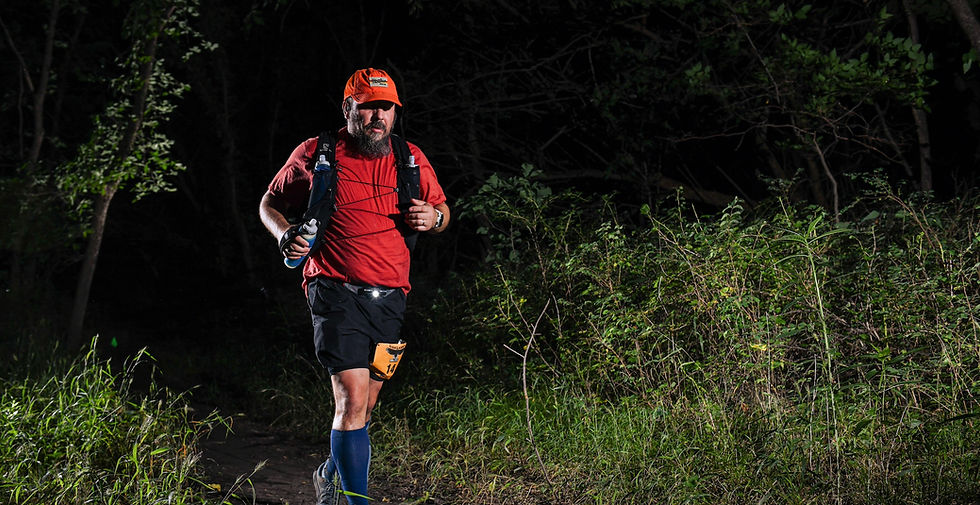
I’ve spent enough of my life in motion that moving can feel less like an action than a way of being. I love the road, and I love running. But I also know how easily movement can be confused with direction.
That’s why Barber’s line landed so sharply:
“All I know how to do is run.”
Some confessions reveal what we’ve done. Others expose the story we’ve begun telling about who we are. This is what I’ve always done. This is all I know. This must be what I am.
I know that story.
The Picture at the Center
Many years ago, Christiane gave me a framed saying attributed to George Moore:
“A man travels the world over in search of what he needs and returns home to find it.”
At the center she placed a photograph of Caleb and Hannah.
I remember seeing it and understanding something about myself. I knew that home was where I had to become grounded and stable. I knew that the people within it required my attention and love. I knew that no distant success could compensate for my absence from the people nearest to me.
But knowledge did not make me faithful to what I knew.
That is very difficult and painful to admit without either defending myself or collapsing into self-condemnation. I understood what the picture meant, yet I failed, and have continued to fail, to give home and the people within it the attention they deserve. I can be physically present and still be moving somewhere else in my mind. Work, projects, ideas, urgency, ministry, exhaustion, even difficult and worthy pursuits can become forms of departure.
In marriage, running does not always involve leaving. A person can remain under the same roof and spend years running. We can flee into work, screens, productivity, religious activity, emotional silence, or the endless problems that appear more urgent than the person in front of us. Physical presence can conceal relational absence.
I know that story too.
The hard question is not simply, Did I stay? It is, Did I return? Did I return my attention? Did I return to the interrupted conversation? Did I return after failure rather than hiding in shame? Did I return to the living person before me instead of reacting to the version I had created in my mind from years of memories, wounds, and assumptions?
Staying is not merely refusing to leave. It is repeatedly returning to the person to whom we have given ourselves.
Movement Is Not Pilgrimage
I love running. I love the road. I love departure, distance, difficulty, and the pull of a distant destination. But none of those things tells me whether I’m traveling toward or away from something worthy.
Movement is not pilgrimage.
Movement becomes pilgrimage when it is ordered toward a worthy destination and the road itself prepares and shapes us to receive it. The key question is not whether I’m moving. It is what or whom I’m moving toward. Is the road making me more attentive, more truthful, and more available to love? Or is movement helping me avoid the place where love has already asked me to remain?
The problem is not running. It is flight: using movement, work, urgency, or even worthy pursuits to avoid the place where love has asked us to remain.
Sometimes Choose Hard means taking the next difficult step. Here it means something different: resisting the reflex to flee, standing still, staying present, and doing the hard work of loving through difficulty.
What We Know Is Not All We Are
Barber’s confession is important because he doesn’t say that running is all he is. What he actually says is that it’s all he knows how to do.
What we know has been learned. What has been learned through repetition can, through grace and new patterns of practice, be changed. A practiced response is not an identity. Habit is powerful, but habit is not destiny.
“I may fail again” can be humility. “I cannot change” is surrender.
Repentance does not pretend that years of formation disappear through one sincere resolution. But it does refuse to grant those years final authority over the future.
The person accustomed to flight doesn’t wait until he feels capable of stability. He practices staying present: one completed conversation, one returned call, one confession without qualification, one evening without escape, one moment of receiving love without arguing against it. Hope is practiced before it is felt. Fidelity is practiced before it feels natural.
The road can carry us away from ourselves, or it can lead us toward the person we are called to become. That may be the decisive question of pilgrimage:
Is this road teaching me how to return?
The Road Ahead
This reflection is an opening into the November Podvig Letter: Pilgrimage — The Road That Leads Home.
The Letter will lead into the Pilgrimage Room, where we will listen more closely to Sam Barber’s album Broken View, paying attention to the movement from “Lighthouse” to “Run” to “I Will Follow,” asking what happens when illumination leads to repentance and repeated flight meets the promise of a vow.
For Podvig Journey members, the road will continue into the Pilgrimage Library’s Take Up Practice path, where the question becomes concrete: How do we recognize our accustomed forms of escape? How do we learn to stay present? How can the roads we travel begin leading us home?

Continue the Journey
Read more: The Mountain Is Not the Task
Follow the weekly rhythm: Dr. Doom’s Commonplace and Dr. Doom’s Patristic Word
Go deeper: Explore Podvig Membership
Receive Podvig Updates
New writing, project updates, and occasional invitations delivered by email.


Comments